Clingy
Clingy is wanting more closeness than the other person is giving, and being visible about it. The dictionaries agree, and every one of them illustrates it with a toddler — a clingy child, Jimmy is a very clingy child. Search it and the second page is Shih Tzus. The word arrives fully formed for people under four; everybody else has to borrow it.
Also written: clingy emoji · clingy meaning · what does clingy mean · clingy girlfriend · needy
What it actually means
There are three senses and yours is last. Oxford opens with clothes: fabric that sticks to the body. Merriam-Webster’s is a child staying very close to someone, such as a parent, for emotional support or protection. Vocabulary.com offers needy and demanding as synonyms and then, in the same entry, the sticky properties of an adhesive. The complaint you actually mean — a grown adult who wants more contact than they are being offered — is the newest of the three and the only one the dictionaries decline to illustrate.
What makes it an awkward word is that it is a measurement taken from the other end. Clingy describes a gap between two people and then files the whole thing against one of them. Two people texting the same amount are close. One person texting more is clingy. Nothing about the behaviour changed — only who else was in the room, and how much they wanted. It is also applied unevenly: clingy girlfriend is one of the questions Google suggests about the word, and clingy boyfriend is not.
Underneath it, usually, is anxious attachment — the conviction that a slow reply is the start of something rather than a slow reply. That is also why the sentiment that circulates about it online is a retreat rather than a definition: clingy right up until it starts to feel like a nuisance, and then abruptly not at all. The person being called it is very often the one watching it hardest. And the word does get used unfairly, because it is also what people reach for when somebody asks them, reasonably, to be consistent. Both are true at once, and the word does not distinguish.
When you’d send it
 Double-texting, and watching yourself do itThe second one was fine. It was fine.
- “Are we okay?” into a perfectly normal TuesdayNothing happened. That is the point.
- Typing, deleting, sending the shorter versionThe shorter version took nineteen minutes.
- Somebody says they need a bit of spaceHeard. Understood. Immediately worse.
- The group photo where one arm is doing the mostYou can pick them out every time.
Why there’s no emoji for it
The keyboard can do closeness and it can do wanting, and it cannot do wanting more than the other person. Every candidate is either mutual — two figures, both holding on — or it is the plea itself rather than a name for it, so you can send how you feel and never what it is called. The word is a comparison, and comparisons do not photograph.
Mutual, welcome and symmetrical: both figures are holding on. Clingy is specifically the one-sided version, which makes this a picture of the same situation going well.
The plea, not the diagnosis. This is what the clingy person sends, which makes it evidence rather than a label — useful for confessing, useless for naming.
The animal people reach for, since clinging is its entire occupation. It is also unbearably cute, so the accusation converts into a compliment somewhere in transit.
Attraction with no direction — magnets pull both ways and equally hard. The asymmetry is the whole word, and this is a picture of physics.
What the dictionaries actually illustrate it with, and exactly why you cannot send it. Nobody means toddler. Everybody would hear toddler.
The exhaustion at the far end of it. Names what being clung to costs and says nothing whatsoever about the person doing the clinging.
The Vigil icon draws the dictionary’s own example and then ages it wrong on purpose. An adult is mid-stride; a second figure has one leg and is being dragged flat along the ground behind them. There are no motion marks, because a horizontal body is already all the motion a drawing needs — and the stride is unbroken, which is the part that stings. The walker has not stopped, has not looked down, and has not registered that anything is happening at all. Being clung to and being untroubled by it are drawn as one picture, because that is usually the arrangement.
Get it
One file each. No email, no account. Use it in anything you make; don’t resell the files.
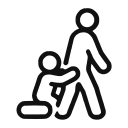
128 px PNG, transparent. Upload it once, then type the name.
Download ↓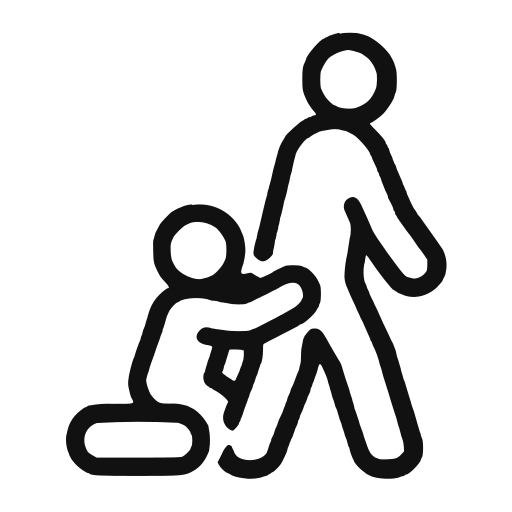
512 px PNG, transparent. On iPhone, long-press it in a message and tap Add Sticker.
Download ↓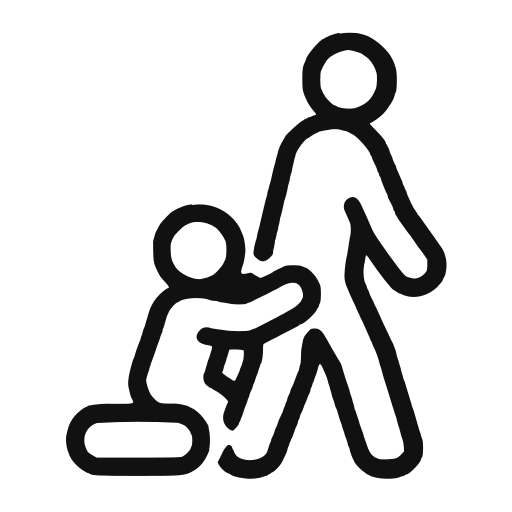
512 px WebP, the format WhatsApp wants. Add it with any sticker-maker app.
Download ↓24-grid, single path, currentColor. Figma, Illustrator, code.
Download ↓Want the whole vocabulary? Every icon in every format, or npm install vigil-icons.
Send these next
Five from the same shelf.
 No. 25Anxious attachmentOne unread message away from a full internal summit.
 No. 5GhostingThe breakup nobody announces.
 No. 22BoundariesNo, said politely. Then said again.
 No. 65Read receipt 2:47amSeen. At a concerning hour. No response.
 No. 16SituationshipToo involved to be casual, too vague to be official.
Questions, answered.
What does clingy mean?
Wanting noticeably more closeness, contact or reassurance than the other person is offering. The dictionaries define it around a child staying near a parent; in everyday use it is a complaint about an adult, and it describes the gap between two people rather than one person on their own.
Is there a clingy emoji?
No. 🫂 is mutual, 🥺 is the plea rather than the label, and 🐨 turns the accusation into a compliment. Vigil’s clingy icon — a figure clamped to a walking adult’s leg and dragged along behind — is free as a Slack or Discord emoji, an iMessage or WhatsApp sticker, or an SVG.
Is being clingy a red flag?
Not on its own. It usually points at anxious attachment rather than anything sinister, and it is also the word people use to dismiss a fair request for consistency. What matters is whether it survives being talked about — the version that will not adjust is the one to worry about.
Why are the clingy search results full of dogs?
Because the literal senses came first and never left. Clingy still means fabric that sticks and a child who will not let go, so the results fill with velcro dogs and toddlers. The version people actually get called is the newest of the three, and the only one without a picture.
How do I add the clingy icon to Slack or Discord?
Download the emoji or sticker pack from vigilicons.com/download. Slack: Customize workspace → Emoji → Add. Discord: Server settings → Emoji → Upload. iMessage: save the PNG to Photos and send it from the photo picker.