Rage bait
Rage bait is content made to make you angry on purpose, because angry people comment. Oxford made it Word of the Year for 2025, after its usage tripled and 30,000-odd public votes put it ahead of aura farming and biohack. It is now a word almost everyone can define and nobody can send.
Also written: rage bait emoji · rage bait meaning · ragebait meaning · what is rage bait · rage baiting
What it actually means
The definitions agree and they are unusually blunt about intent. Cambridge files rage bait as information, images or videos put online deliberately to make people angry and get them replying, and keeps a second entry for rage baiting, the activity. Merriam-Webster has it as intentionally offensive or provocative content designed to elicit anger — though it still sits on the slang side of the house rather than in the main dictionary, which is a strange place for a word Oxford just crowned. Wikipedia files it under rage-baiting and lists the farmer’s vocabulary that grew around it: rage-farming, rage-seeding.
What makes it a genuinely new word is that it names the motive, not the thing. Clickbait describes a promise the page does not keep. Trolling describes a person enjoying themselves. Rage bait describes a business decision: anger out-comments delight, comments are reach, and reach is money, so somebody salts a recipe video with the wrong ingredient and waits. That is the real difference people search for between trolling and rage baiting — a troll wants your reaction, a rage baiter wants your reaction monetised. One is a hobby. The other has a spreadsheet.
And it has walked off the platform. The searches that cluster around it now are rage bait in a relationship, rage bait at work, rage bait psychology — people using it for a person in the room who says the provoking thing on purpose and then watches. No dictionary has that sense yet; all of them still define it as content. The word was built to describe a post and has been quietly repurposed to describe a colleague, which is usually the sign that a piece of internet vocabulary is going to last.
When you’d send it
 The recipe video that puts the wrong thing in on purposeForty thousand comments. All of them corrections.
- A take so bad it has to be deliberateIt is. That is the product.
- Typing a reply, then deleting it, then typing it againThe draft was the whole goal.
- Quote-tweeting to dunk, and handing over the reachThe dunk counts as engagement too.
- Spotting the bait and commenting anywayKnowing has never once stopped anybody.
Why there’s no emoji for it
The keyboard has the anger and it has the fishing, but never the two together, and never the part that matters — that somebody did it on purpose and is pleased. Every available piece shows either the trap or the victim. Rage bait is the arrangement between them.
The bait half, and the closest single character. On its own it reads as a pleasant weekend, not a trap with a motive.
You, caught. It names the victim and says nothing about the person holding the rod.
Hardware. Accurate and completely neutral — it could be a coat hook, and it carries no anger at all.
Attraction without provocation. Close to the mechanism, wrong about the feeling: a magnet does not want you annoyed.
The aftermath, and hopelessly overloaded — fire now mostly means something is good, which is the opposite verdict.
Maximum fury, still pointed the wrong way. It is a picture of the person who fell for it, which is the part nobody wants to send.
The Vigil icon hangs a speech bubble off a fish hook, and puts a furious face inside the bubble. The hook is the intent and the bubble is the post; the anger is in the content, dangling, waiting. The emphasis lines are there because it is working. Nothing in the drawing is angry on its own — it is an arrangement, which is what the word actually names.
Get it
One file each. No email, no account. Use it in anything you make; don’t resell the files.
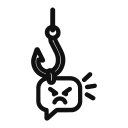
128 px PNG, transparent. Upload it once, then type the name.
Download ↓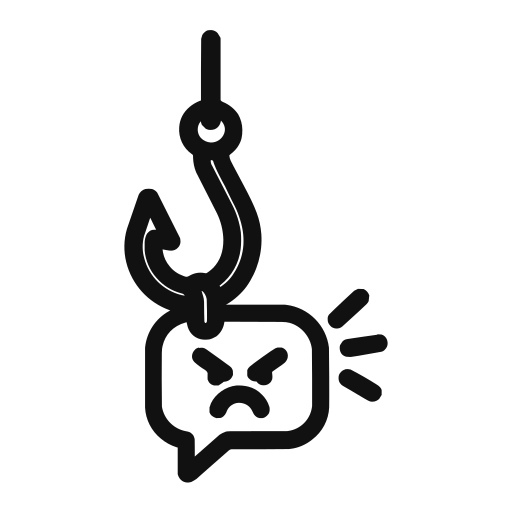
512 px PNG, transparent. On iPhone, long-press it in a message and tap Add Sticker.
Download ↓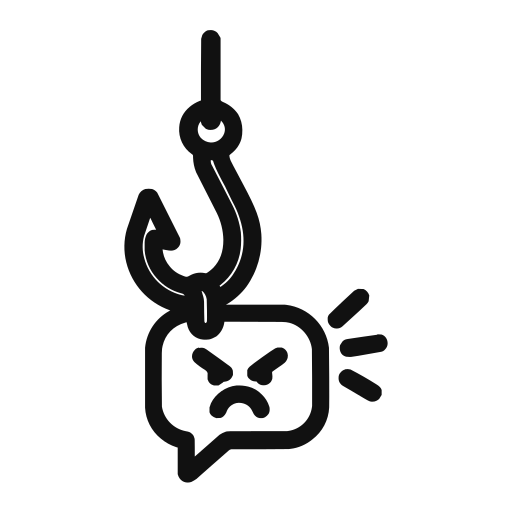
512 px WebP, the format WhatsApp wants. Add it with any sticker-maker app.
Download ↓24-grid, single path, currentColor. Figma, Illustrator, code.
Download ↓Want the whole vocabulary? Every icon in every format, or npm install vigil-icons.
Send these next
Five from the same shelf.
 No. 82Hot takeAn opinion served above the recommended temperature.
 No. 60NPCRunning the same dialogue tree on repeat.
 No. 63DoomscrollingStill scrolling long after the information stopped helping.
 No. 85Brain rotWhen the feed starts marinating your frontal lobe.
 No. 38Terminally onlineKnows the discourse. Has not seen daylight.
Questions, answered.
What does rage bait mean?
Content posted deliberately to make people angry, because anger produces comments and shares, which produce reach and revenue. Cambridge and Merriam-Webster both define it by that intent, not by the subject matter.
Why was rage bait Oxford’s word of the year?
Oxford chose it for 2025 after its usage roughly tripled over the year, with more than 30,000 public votes putting it ahead of the other shortlisted terms, aura farming and biohack.
What is the difference between trolling and rage baiting?
Motive. A troll provokes for their own amusement and may have no audience in mind. A rage baiter provokes for the engagement it generates, because angry replies travel further than agreement — it is trolling with a revenue model.
Is there a rage bait emoji?
No. 🎣 is a quiet hobby, 😡 is the person who fell for it, and 🪝 is hardware. Vigil’s rage bait icon — a speech bubble with a furious face in it, hanging from a hook — is free as a Slack or Discord emoji, an iMessage or WhatsApp sticker, or an SVG.